Moran seismogram
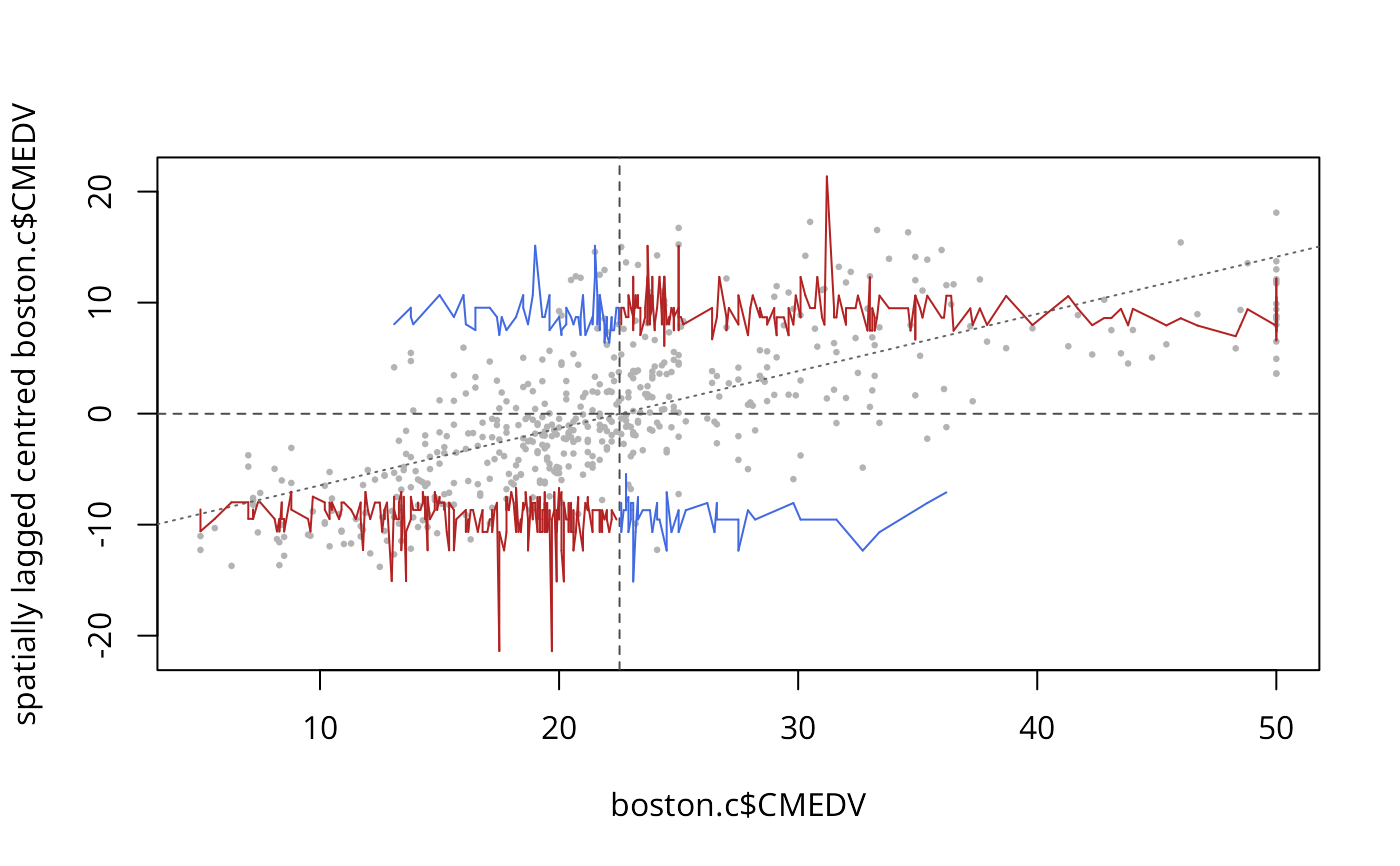
moran.plot.seismogram.RdA variant of the Moran scatterplot (see moran.plot) supplemented by lines connecting location-wise critical value configurations of attribute values and spatial lags. The plot allows for visual inspection of potential spatial weights misspecifiation.
Usage
moran.plot.seismogram(x, listw, locmoran, alpha = 0.05, adjusted_p = NULL,
  xlab = NULL, ylab = NULL, return_df = TRUE, spChk = NULL,
  zero.policy = attr(listw, "zero.policy"))
Arguments
- x
a numerical vector holding the attribute of interest
- listw
a
listwspatial weights object- locmoran
a fitted object of type localmoran
- alpha
default 0.05; the desired significance level regarding local Moran's I
- adjusted_p
default NULL; an optional vector of p values adjusted to account for multiple testing as is returned by
p.adjustSP; if NULL, standard normal approximation is used to determine critical values- xlab
default NULL; an optional label for the x-axis
- ylab
default NULL; an optional label for the y-axis
- return_df
default TRUE; invisibly return a data.frame object, if FALSE do not return anything
- spChk
default NULL to use
get.spChkOption(); should the locmoran names be checked against the listw spatial objects for identity integrity, TRUE, or FALSE- zero.policy
default option stored in the listw object; if FALSE stop with error for any empty neighbour sets, if TRUE permit the weights list to be formed with zero-length weights vectors
Details
The Moran seismogram is a version of the Moran scatterplot that is complemented by lines connecting the location-specific critical values of local Moran's I in the plot. The y-coordinates associated with the critical value are determined either under the assumption of approximate standard normality of the z-scores of the local Moran's I values, or based on p values provided through adjusted_p. In the latter case, the critical value is approximated based on the observation with the highest adjusted p value that still satisfies the selected significance level. Lines in quadrants with positive spatial autocorrelation are shown in red and lines in quadrants with negative spatial autocorrelation are shown in blue. The representation is similar to a seismogram for detecting earthquakes and thus reveals potentially suspicious local spatial weights configurations by visualising spikes. The latter are displayed in an integrated manner with their positions in the attribute value range and in connection with the types of the associated spatial patterns (by the quadrants of the scatterplot).
Value
When return_df is TRUE, a data frame object with the following members is returned:
- labels
either the labels provided or the region ids, if not specified
- x
the attribute values
- wx
the spatial lags of the centred attribute values
- b
the y-coordinates (i.e. hypothetical spatial lags) of the critical values given x
References
Westerholt, R. (2024): Extending the Moran scatterplot by indications of critical values and p-values: introducing the Moran seismogram and the drop plot. Proceedings of the 32nd Annual GIS Research UK Conference (GISRUK), Leeds, UK. doi:10.5281/zenodo.10897792
Author
Rene Westerholt rene.westerholt@tu-dortmund.de
Examples
# Boston example (CMEDV; owner-occupied housing in USD)
data(boston)
boston.tr <- sf::st_read(system.file("shapes/boston_tracts.gpkg", package="spData")[1])
#> Reading layer `boston_tracts' from data source
#>   `/home/rsb/lib/r_libs/spData/shapes/boston_tracts.gpkg' using driver `GPKG'
#> Simple feature collection with 506 features and 36 fields
#> Geometry type: POLYGON
#> Dimension:     XY
#> Bounding box:  xmin: -71.52311 ymin: 42.00305 xmax: -70.63823 ymax: 42.67307
#> Geodetic CRS:  NAD27
boston.nb <- poly2nb(boston.tr)
boston.listw <- nb2listw(boston.nb)
moran.plot.seismogram(boston.c$CMEDV, boston.listw,
 localmoran(boston.c$CMEDV, boston.listw), 0.01, zero.policy = TRUE)